Clearstories

I’ve been collaborating with photographer Stephen Petegorsky on a set of paired poems and photos, titled Clearstories. An excerpt from the project has now been published as an online chapbook at Terrain.org:

Clearstories

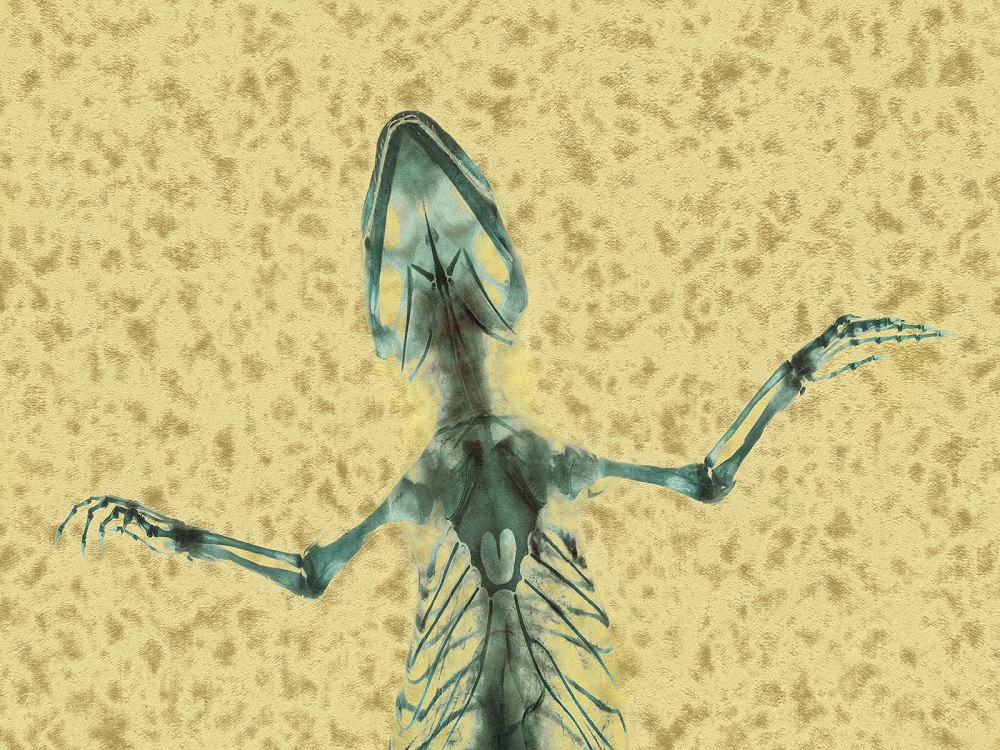
The project explores animal specimens that have been cleared and stained, a process in which they are treated with an enzyme to turn soft tissues transparent, then stained to make bones and cartilage stand out for studies of anatomy and morphology.

Two photo/poem pairs were also featured in Amherst Magazine.
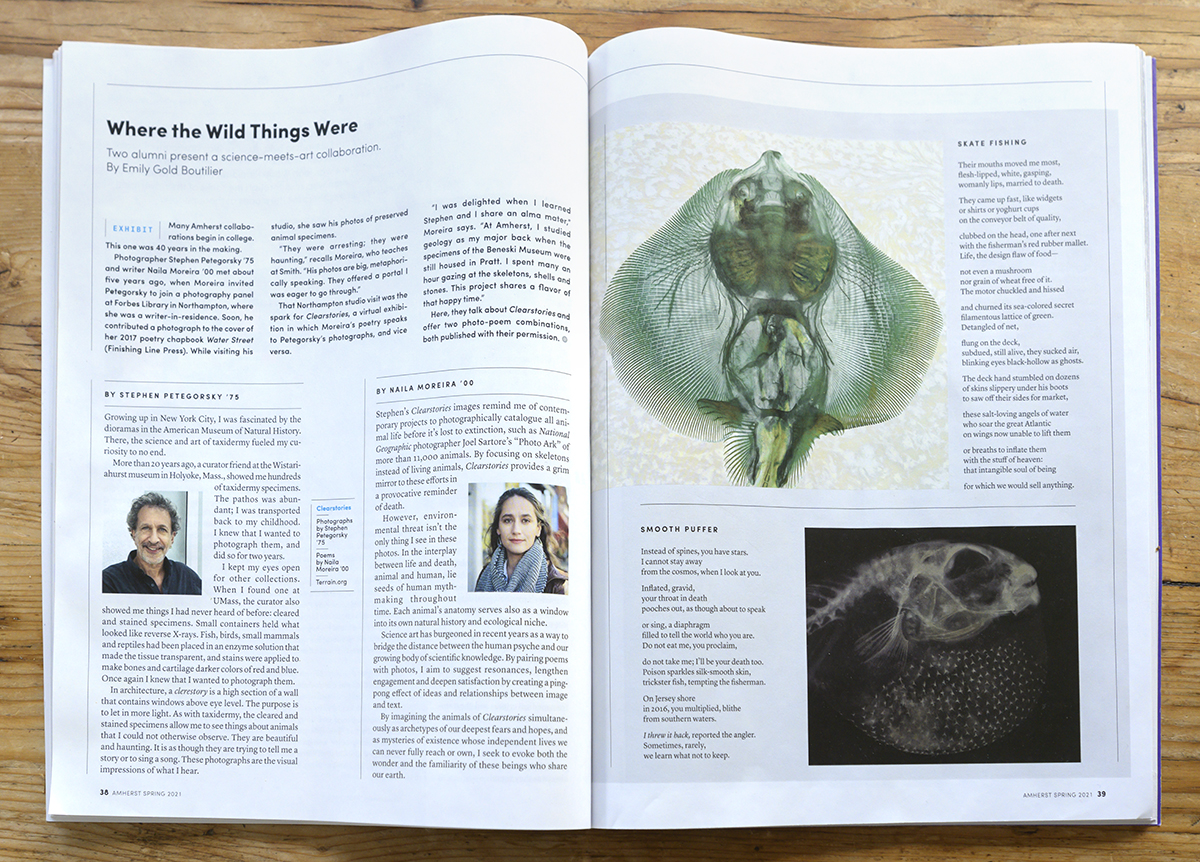
Photo of Amherst Article

Top image: Fringe-Toed Sand Lizard, by Stephen Petegorsky.
Porcupine

My poem “Porcupine” is published this month in the Cider Press Review, and can be found here:

Porcupine

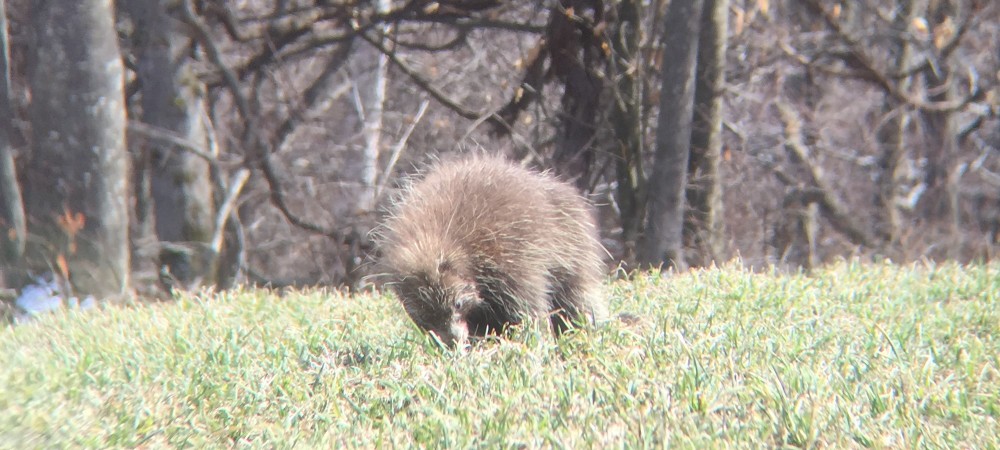
I wrote this poem watching a porcupine cropping grass at Smith College’s MacLeish Field Station in Whately, MA. I also caught a photo, shown above.

Sleeping in the Forest

Thinking of Mary Oliver today as this riff on my favorite of her poems, the beautiful Sleeping in the Forest, arrived in my mailbox in this year’s Connecticut River Review. In honor too of my high school summer writing students who shared this moment with me.

Pomegranate

On my return from ten days on Cape Cod, I was excited to learn that my poem “Pomegranate” was selected as the 2nd-prize winner in the Poetry Society of New Hampshire’s national competition. Poet Alfred Nichol was the judge.

The poem will appear in an upcoming issue of The Poets’ Touchstone.

Hooray!

New England Poetry Club

I’m so pleased and eager to announce that I’ll be this year’s judge for the New England Poetry Club 2019 Jean Pedrick Chapbook Prize. The award goes out to a chapbook published within the last two years.

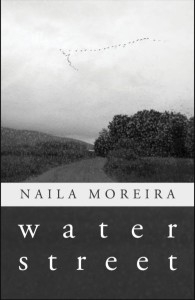
My chapbook Water Street, from Finishing Line Press, won last year’s Pedrick Prize (alongside co-winner C. Prudence Arceneaux’s Dirt), so I’m looking forward to this chance to give back to the poetry community.

Selections from Water Street are now posted in the 2018 NEPC Prize Winner’s Anthology. Of the collection, judge Krysten Hill said:

What drew me into Naila Moreira’s Water Street was its immersive descriptiveness that never underestimates the power and tension that the natural world can embody. These powerful poems delivered me to all kinds of ecosystems thriving just underneath the surface in all their violent glory. There are times when the natural world collides with human destruction to create a sinister chain reaction. Moreira reminds us of a world where “…planes fall, frogs spawn/against backdrop of rubber, plastic, steel;/a thousand eggs; a thousand tiny bombs./They hatch into a universe of fear.” The speaker exists in nature’s hiding places and out in the open where they are exposed and vulnerable to the vulnerability that they see in nature. At times, these poems suggest a disquieting tone that haunted me throughout the day. At other times, I felt a liberating honesty and was grateful for how it shook me awake. —Krysten Hill

Chapbooks can be submitted via the NEPC submissions guidelines. I’m thrilled to read and explore the poetic work that comes my way for the Pedrick Prize.

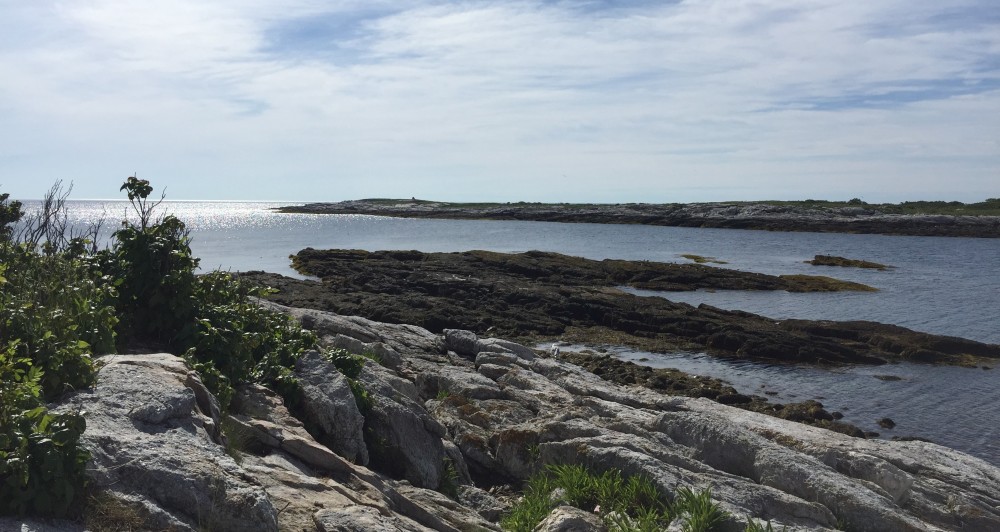
Picture of Smuttynose Island viewed from the shore of Appledore Island

The Isles of Shoals – Poems

This summer, I had the extraordinary opportunity to spend June as artist in residence at the Shoals Marine Laboratory on Appledore Island, one of the Isles of Shoals off the coast of Maine and New Hampshire.

As the first poet they’d had in the position, I spent many hours wandering the sea-washed granite outcrops, peering down microscopes alongside parasitology students, observing marine mammals with smart, passionate marine biologists, and accompanying sustainable fisheries experts on the boats of generous local fishermen to observe fishing practices.

Poetry has a long history on the Isles. In the late 1800s, poet and lighthouse keeper’s daughter Celia Laighton Thaxter ran a hotel and artists’ salon on Appledore, attracting visitors like Thoreau, Mark Twain, and Childe Hassam. Her poem The Sandpiper is one of my enduring favorites.

I wrote a lot during my short stay, inspired by the landscape, the animals, the fervor for exploration and discovery among the scientists, staff and students. Here are three poems published today by The Island Review.

On the Isles of Shoals

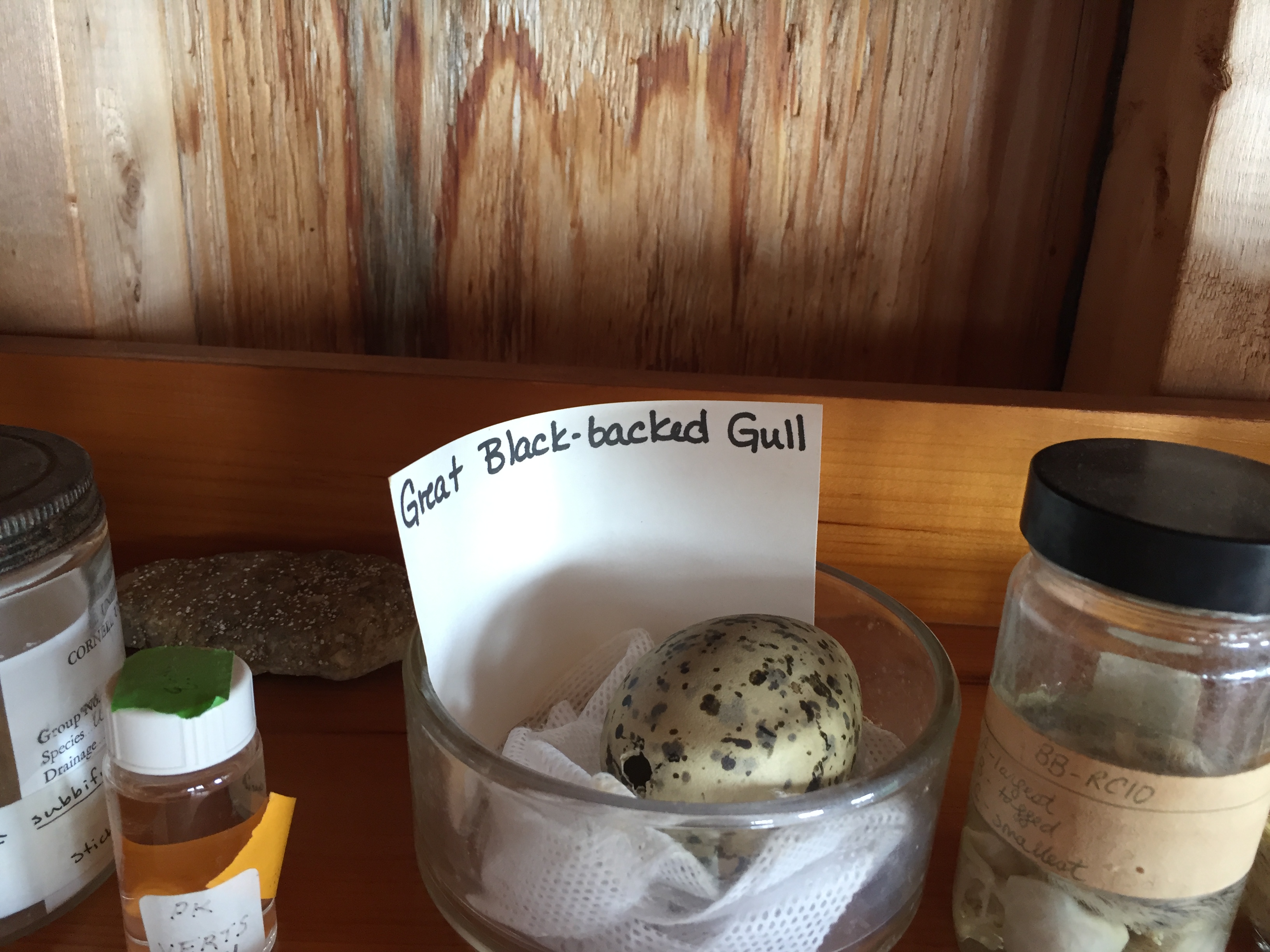
GullsEgg

Dusk at MacLeish

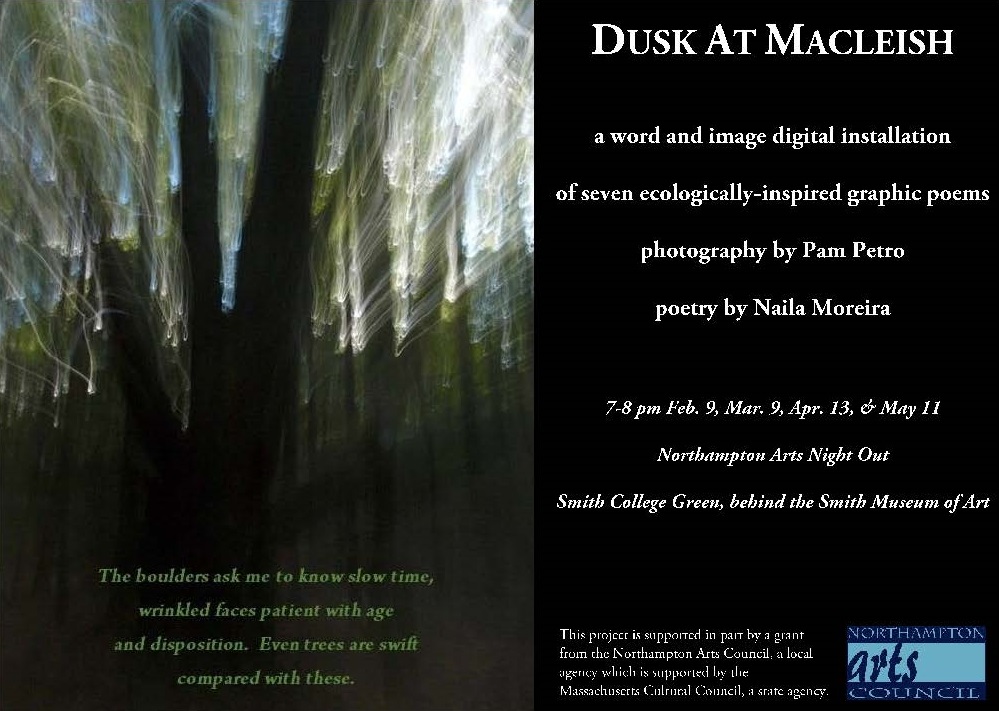
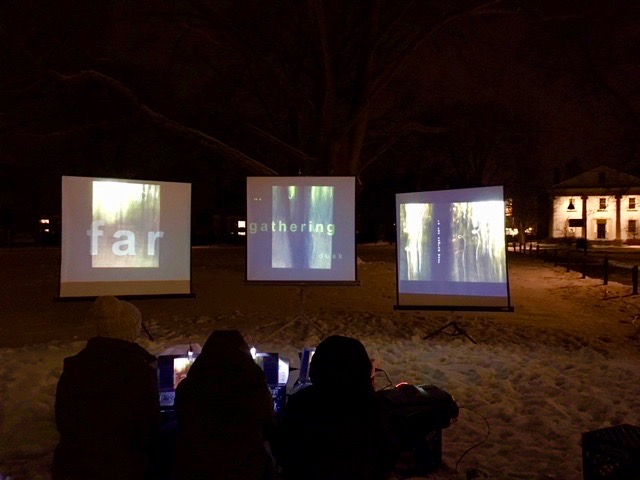
Dusk At MacLeish is a digital installation of ecologically inspired “graphic poems” at Smith College, a collaborative project pairing my poetry with the photograpy of Pamela Petro.

NOTE: The April and May showings will take place at 8 pm to accommodate the changing light.

Dusk at Macleish flyer

The poems and photos reflect on the forest landscape at the MacLeish Field Station in Whately, Masssachusetts, at dusk – its betweenness, liminality and fragility.

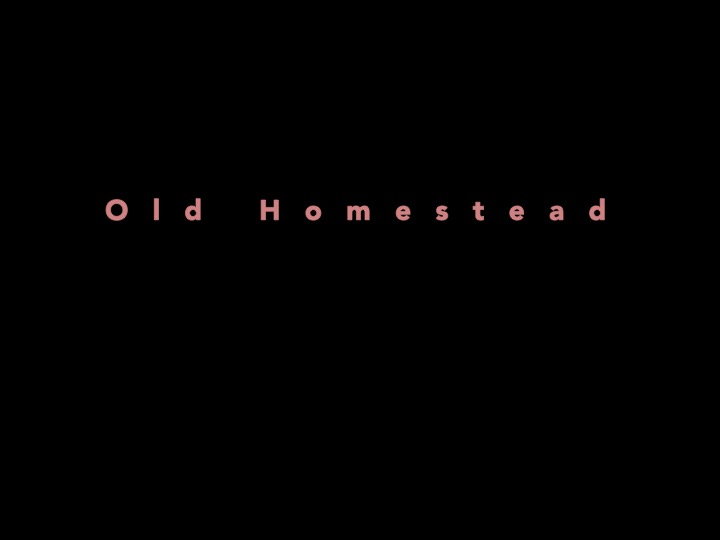
Below, one of the graphic poems, Old Homestead. Click for a slideshow.

The installation in progress:

Feb install 1

NEPR Interview – Water Street

This summer, I was interviewed about my chapbook Water Street by New England Public Radio’s Karen Brown for her summer literary series.

Summer Fiction: ‘Water Street’ by Naila Moreira

Naila Moreira is a science and environmental journalist who also writes poems. Her new book of poetry, “Water Street,” is immersed in the natural world. She wrote it while living alone in a farmhouse apartment on the Mill River in Leeds, Massachusetts.