Immune system in a computer

I have an article out in Science News for Students this week, on the immune system, and how computers are allowing us to create simulated immune-cell interactions that mimic the human body and healing:

Virtual Wounds: Computers probe healing

It’s written for young people age 8 to 18.


When the body needs to deliver immune cells to an injury, new blood vessels form. Here, an agent-based model imitates that. It shows what happens when mouse eye tissue (on left) gets blood vessels from developing eye tissue (on right). Image credit: Joseph Walpole, University of Virginia

Collecting Plants

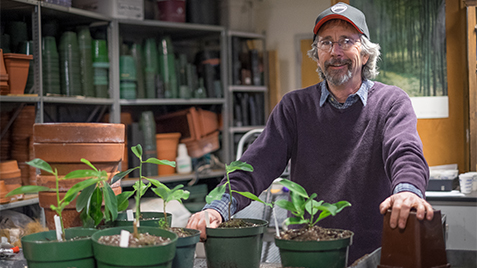
I have a profile out today in Smith College’s Insight magazine, on Smith College Lyman Conservatory manager Rob Nicholson. It describes his adventures in plant-collecting expeditions around the globe:

An Aztec curse seemed like a minor obstacle as Rob Nicholson, manager for the Lyman Conservatory of the Botanic Garden of Smith College, climbed a monkey-hand tree in Oaxaca, Mexico, to gather plant samples. But then he fell out of the tree. …. Read on for more stories from the collecting trips that have taken Nicholson all over the world.

http://www.smith.edu/insight/stories/nicholson.php


Image credit: Smith College Insight magazine

Hope

Alison Hawthorne Deming, a poet and essayist who focuses on issues of science and the environment, visited Smith this week to speak from her work. She had some wonderful comments during a Q&A on her writing.

I always ask environmental writers how they maintain hope in the face of the immense challenges we face: species extinction, climate change, overpopulation, water shortages, pollution, ocean acidification and coral bleaching, overfishing …. the list goes frighteningly on and on.

Hawthorne Deming called on the ideas of W.S. Merwin. “He said, when you’re in a life raft, that’s the time for your best behavior, not your worst behavior. We have to choose to have hope.” She went on to say that “when we’re experiencing loss and grief, we should work on that loss… What remains is the more precious to us.”

She spoke of that work on loss very beautifully as “an instruction to the moral imagination” to be given to us by ourselves.

I’m reminded of a song by The Flaming Lips titled “The Gash (Battle Hymn for the Wounded Mathematician).” It’s a brilliant anthem for embattled scientists everywhere:

Is that gash in your leg
Really why you have stopped?
Cuz I’ve noticed all the others,
Though they’re gashed, they’re still going,
And I feel like the real reason
That you’re quitting is admitting
That you’ve lost all the will
To battle on

Will the fight for our sanity
Be the fight of our lives?
When we’ve lost all the reasons
That we thought that we had …

So the battle that we’re in
Rages on, ’til the end
With explosions, wounds are open
Sights and smells, eyes and noses,
But the thought that went unspoken
Is understanding that we’re broken
Still the last volunteer battles on
Battles on ….
Battles on ….

listen on youtube

Marvelous.

Hawthorne Deming also commented on her writing process. She started by mentioning that an essay she’d just read from “operates largely by digression – one of the essayist’s great friends.” Indeed.

She writes poems, she said, by “writing down snippets in a notebook and looking for some charge …. When I’m stuck, I go through a fairly manic process of pulling books off the shelf. I’m not going to plagiarize, but I’m going to steal a device. How do people end poems, anyway?” Fitting, for a poet whose work bubbles over with cleverly deployed references to literature and science.

“I won’t say poems arrive ready made,” she said, “but the impulse arrives. And when the impulse arrives, I try to put down whatever I’m doing and write it. That particular constellation of energy, passion, whatever it is, might not be there [later].”

She’s interested, she said, in developing what it means to be a woman in the 21st century, and all it entails – a theme that preoccupies me also.

Between essays and poems, “the poems are a little more mysterious,” she said. “I’m not always really sure where they come from or where they’re going.”

And so, following those little mysteries on their journey into the dark and lightness of the human soul, I’ll close this entry for tonight.

Night. A woman betrayed.
Insects gather
on the cabin window
so that all she can see
is a plague of gray moths.
She’s sick of the body’s
dumb song, the frenzy
of insects for light.
Why does a moth do that
if it’s nocturnal?
If it woke up in the daytime,
it could simply
have what it wants.

Alison Hawthorne Deming

A Fitbit in a band-aid

Health monitors to measure heart rate and steps per day are getting smaller and smaller, and cheaper and cheaper. Soon, researchers say, they’ll be the size of a band-aid, flexible, and disposable. Plus, they’ll measure chemicals in sweat that could detect stress, fatigue, or even heart or liver failure. My latest article, on new nanotechnology manufacturing efforts that should make this sort of device possible within 5 years:

UMass patch would spot stressed-out soldiers – Boston Globe


Image Credit: Boston Globe

Winter Notebook

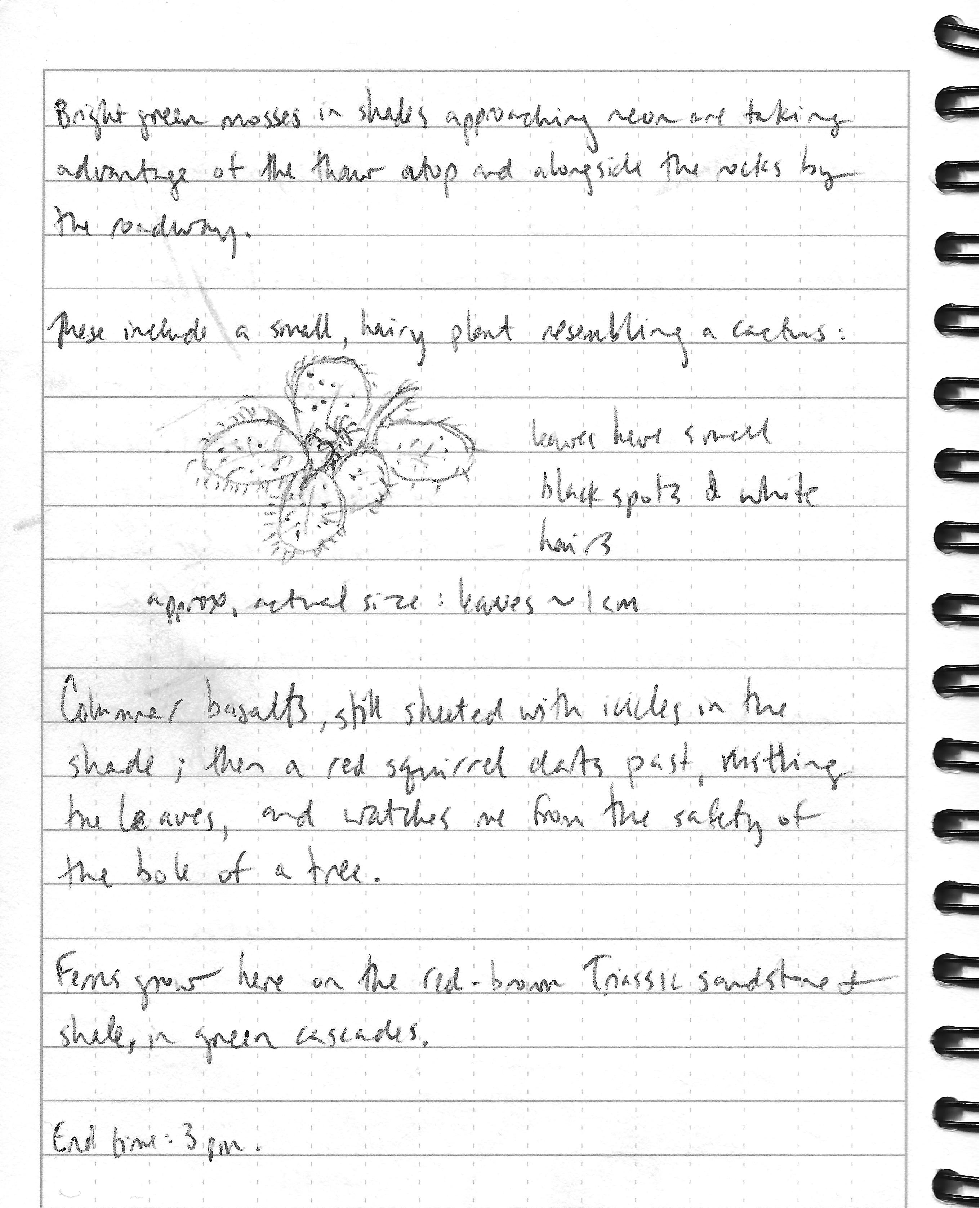
There’s something special about seeking out nature in the unforgiving seasons. In memory of winter, now that spring has at last stolen over the landscape, I thought I’d share this nature notebook entry from the last days of December.

decnotebookpg1

The mosses were bright green in the brief melt, taking advantage of warming.

succulentplant

Among them I found this strange, small plant, described below:

decnotebookpg2

At three p.m. it was time to hike home.

forestpath

Diving to the sea bottom

Latest article in the Boston Globe: Eric Schmidt, executive chair of Google, and his wife, Wendy, own the only privately-owned oceanographic research vessel on the sea, the R/V Falkor. They provide grants for ocean scientists worldwide to do deep-ocean mapping and pure oceanographic research from on board.

Article

Most excitingly, in my opinion, they’re now designing a brand new deep-sea submersible as a permanent fixture for the Falkor, in collaboration with Woods Hole Oceanographic Institution. It’ll be one of just two robotic divers worldwide able to dive to the ocean’s deepest environments, like the Mariana Trench almost 11 km below the surface.

The Schmidt Ocean Institute, which runs the Falkor, has loads of fantastic video, photos, and info from the ship’s expeditions here:

http://www.schmidtocean.org/


Julie Huber of the Marine Biological Laboratory in Woods Hole and Mario Fernandez of WHOI, collecting samples.  Image: Chris German, provided by Schmidt Ocean Insitute

The loss of the frog prince

Frogs. They’re familiar and otherworldly, slimy and charming, the kind of odd liminal animal that spurs the imagination. Their voices range from the brute croak of the bullfrog to the fairy-sweet, bell-like chorus of the spring peeper. Our complex relationship with frogs shows up even in our childhood in the deeper meanings of the well-known fairy tale, The Frog Prince – ranging from a moral injunction on the rewards for living up to one’s promises, to a symbol of a young princess’ maturation from childhood to adulthood in the transformation of frog to prince on her pillow.

So the plight of frogs worldwide touches a special and symbolic chord. A deadly fungus, the amphibian chytrid, has led to as many as 30% of all frog species worldwide being threatened with extinction since it first appeared in 1993 – and hundreds are already extinct. What would our world, from the literary to the literal, be without frogs?

No one understands how to slow chytrid’s spread. But a study today in the journal PLOS ONE suggests we may have been studying the fungus too narrowly. Biologist Kevin Smith and his colleagues at the University of Washington St. Louis found that of all Missouri ponds expected to harbor the fungus, only a third actually had chytrid present. Frogs in the remaining ponds were healthy and chytrid free – even when the ponds had the right chemistry and water temperature for the fungus.

“Focusing only on amphibians to understand chytrid is like focusing only on people to understand Lyme disease,” says Smith. Just as deer, and in turn deer ticks, carry Lyme, other organisms besides frogs may serve as hosts for the chytrid. Without the presence of these animals or plants, Smith theorizes, the chytrid wouldn’t be able to survive long, and wouldn’t therefore infect nearby frogs. The study is a start in trying to take a wider, ecosystem-level view of the chytrid and its requirements for growth.

But it won’t, of course, allow us turn around and save the frogs. Biologists and frog enthusiasts are so worried that they’ve begun keeping frog exemplars in captivity – using networks of zoos and other institutions, such as the Amphibian Ark, to harbor rare living frogs until the chytrid can be more effectively battled.

The last known Rabbs fringe-limbed treefrog, for instance – collected early on in the chytrid epidemic along with others that have since died of natural causes – lives at the Atlanta Botanical Garden in a special enclosure. His handlers have nicknamed him Toughie, and say they try to touch him as little as possible. “It’s pretty nerve-wracking taking care of him,” says the Garden’s Mark Mandica.

I’ll take a new, healthy generation of Toughie tadpoles over a prince, honestly. What do I have to kiss, tell me, to achieve that miracle?

*

This post is the first in a series of science tidbits, short cogitations on recent science findings that interest me and on why they do.